Artificial Intelligence
Prediction and optimization turn signals into useful actions. Evaluate decision quality alongside errors, review effort and the ability to intervene in time.


WELCOME TO SOFTMAG
Exploring the Technology That Shapes Tomorrow
Software shapes how people learn, businesses operate and communities solve problems. SOFTMAG brings that changing world into focus through clear explanations, practical perspectives and the decisions behind useful technology.
This August edition explores artificial intelligence, cloud computing, cybersecurity, startups and digital transformation. We connect the promise of new capabilities with the work required to make them dependable, understandable and worth using.
To inform, inspire and connect the global technology community through high-quality content on software, AI, innovation and the people shaping our digital future.
We examine mechanisms as well as possibilities: how systems connect, where authority belongs, what a team should measure and which tradeoffs deserve attention before an investment becomes a commitment.
Features combine editorial analysis with explanatory scenarios, technology images and visual guides. Sources accompany named-company coverage and dated news. Practical questions help readers carry each idea into a more informed conversation with their own teams.

EDITOR’S NOTE
Progress begins when a powerful idea meets a useful purpose.
Technology is changing the way businesses make decisions, the way developers create products and the way people participate in an increasingly connected society. The important question is no longer simply what a new tool can do. It is what an organization should change, and how it will know whether that change helps.
Artificial intelligence makes that question especially visible. Prediction, generation and agentic workflows offer different capabilities. Each needs suitable evidence, clear authority and a way for people to inspect the result. A convincing demonstration becomes a dependable service through careful evaluation and ownership.
Cloud transformation follows the same principle. Moving an application is a milestone; improving its adaptability and recovery is the continuing task. Teams need to understand dependencies, operating costs and the choices that help a service remain useful when conditions change.
Cybersecurity belongs in those choices from the beginning. Identity, software delivery and recovery planning influence the confidence with which an enterprise can act. Sustainable engineering adds another responsibility: examine the resources behind useful work and remove demand that produces no meaningful value.
People remain central to the story. A workplace tool should improve shared understanding. An immersive interface should make a task easier to learn or perform. A digital service should account for the language, connectivity and working conditions of the people expected to use it.
For startups and developers, these constraints are also opportunities. A narrow recurring problem can be the beginning of a useful product. Clear interfaces, open foundations and disciplined feedback can help a small team focus its effort on the part that matters most to its users.
Across this edition, we connect emerging ideas with practical judgment. Read the features as invitations to ask better questions: who owns the outcome, what evidence would change the decision and which next step is small enough to learn from? Tomorrow becomes more promising through the quality of the work we choose today.
TABLE OF CONTENTS / 1
Your guide to the connected enterprise.


TABLE OF CONTENTS / 2
Your guide to the connected enterprise.


COVER STORY
How AI, cloud and digital innovation are reshaping the way businesses work.
The connected enterprise brings software, information and people into a shared operating rhythm. When sales, inventory and service systems agree on the facts, teams can respond to customers without rebuilding the story at every handoff.
Progress depends on more than adopting new tools. It requires shared definitions, reliable interfaces and clear ownership of the decisions that follow. A faster data connection has limited value if nobody is responsible for resolving an exception.
The next wave of useful innovation connects intelligent systems with accountable decisions.
Prediction and optimization turn signals into useful actions. Evaluate decision quality alongside errors, review effort and the ability to intervene in time.
Adaptable services support changing demand. Dependability requires tested recovery, secure identity and clear ownership across the complete application.
APIs and shared events coordinate work across applications. Stable identifiers and reconciliation preserve useful information when messages arrive late or dependencies fail.
Start with one important customer journey. Map its dependencies, agree on the authoritative records and measure where manual reconciliation causes delay.
Then improve the weakest handoff. A bounded, observable change gives the team evidence to guide the next investment—and a practical route to a smarter enterprise.

CONNECTED ENTERPRISE / CONTINUED
A connected world needs connected accountability.

A useful integration map begins with a business event. An accepted order changes stock commitments, delivery expectations and financial exposure. Give each event a stable identifier and a versioned schema. Consumers record what they have processed so a retry does not create a second shipment. Treat late information as an expected condition and provide a visible exception route. A shared status should also explain freshness. A stock figure updated moments ago and a delivery estimate waiting for a carrier response represent different kinds of evidence. Showing that distinction helps a service employee give a useful answer without pretending that every connected system has already reached the same conclusion.
Imagine that the warehouse accepts an order but the acknowledgement never reaches the sales system. A second request should retrieve or reconcile the first commitment, rather than reserve the stock again. This is why identifiers and repeatable processing belong in business architecture discussions, alongside the more visible features of a connected platform.
A shared exception queue should explain the affected customer, the missing dependency and the person able to resolve the problem. It should also distinguish information that is delayed from information that is contradictory. That clarity gives staff a practical way to continue work while the underlying integration is repaired.
Shared visibility does not require every team to use one application. It requires agreement about the meaning of a record and who may change it. A customer-service screen can assemble current facts from several services while the originating systems retain their responsibilities. Document freshness expectations so users understand when a displayed answer may lag. An integration review should include a deliberately interrupted journey. Pause a dependency, replay a message and update a record out of sequence. The exercise reveals whether the architecture preserves the business commitment when the environment stops behaving perfectly.
Choose the next integration by the uncertainty it removes. A reliable delivery promise may matter more than adding another dashboard. Review whether customers receive clearer answers and employees spend less time reconciling records. Those observations make connected technology a continuing improvement program, rather than a one-time installation.
Measure order-to-delivery time, exception age and the percentage of cases requiring manual reconciliation. Pair these with integration reliability so teams can distinguish a business bottleneck from a technical failure.
SOURCES & FURTHER READING / AWS Well-Architected Framework
SOFTMAG editorial analysis. Business scenarios and diagrams are explanatory examples.
DIGITAL TRANSFORMATION
Redesign the work before buying the platform.

Original AI-assisted editorial illustration · Digital transformation
Digitizing an existing form can make a bad process faster without making it better. Transformation asks whether the approval, handoff or duplicate record is necessary at all. The unit of change is a complete business journey, not a collection of software licenses. A transformation program also changes the distribution of work. Removing a manual step may expose a policy ambiguity that employees previously resolved through experience. Capture that judgment before replacing the person’s workaround with a rigid automated rule.
Begin by observing actual work. Follow a request through queues and exceptions, including the unofficial spreadsheet used when the main system fails. Separate rules required for control from habits that persist because nobody has challenged them. Give the pilot a clear decision owner. Procurement, operations and technology can contribute expertise, but someone must decide whether evidence supports the next phase. A shared backlog helps distinguish an essential exception from a request to recreate the old process.
Imagine a distributor redesigning returns. Customers submit evidence once, the warehouse checks the same case record and finance sees the accepted outcome. A visible status replaces repeated calls. The team can then automate routine cases while reserving unusual claims for review.
The best digital process removes work.
Technology and incentives need to move together. A department rewarded only for its own processing speed may push incomplete work downstream. Give a cross-functional owner authority to improve the whole journey and involve frontline staff in testing.
DIGITAL TRANSFORMATION / CONTINUED
The best digital process removes work.
Process discovery should include the people who handle exceptions. A neat flowchart may omit the customer who sends incomplete evidence or the employee who cannot access the approval screen. Observe those cases and decide which need a simpler rule, a better interface or a human decision. Technology should make that choice visible rather than bury it.
During a transition, employees often maintain the old spreadsheet as well as the new application. This can be sensible while confidence develops, but it needs an end condition. Decide which checks demonstrate readiness, who authorizes the switch and how important historical information will remain available afterward.
Routine cases are only part of a process. A return without an invoice, an unavailable approver or an incomplete address should lead to a comprehensible next step. Test these cases with the people who handle them today. Their judgment can reveal where the workflow needs flexibility rather than more automation.
Build a pilot around a complete slice of work: one return type, one branch or one customer group. Keep an explicit old-process fallback during the transition. Explain what changes for each role and give employees a way to report a broken handoff. Adoption improves when the new path reduces effort instead of adding a second system to maintain. Keep a change log of what users learned during the pilot. A new training need and a broken workflow require different responses. Treating both as resistance to change can conceal a genuine design problem and make future feedback harder to obtain.
Transformation becomes durable when the new way of working is easier to understand and support. Preserve the learning from the pilot, retire redundant steps deliberately and keep an owner for the complete customer journey. The technology can then evolve without forcing the organization to repeat the same discovery work.
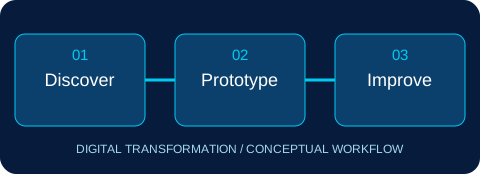
Track end-to-end completion time, repeat contacts and rework. Launch with a small group, keep a fallback and compare results with the previous workflow. Adoption is a clue; a better customer outcome is the goal.
SOURCES & FURTHER READING / Microsoft: enterprise adoption methodology
SOFTMAG editorial analysis. Business scenarios and diagrams are explanatory examples.
APPLIED AI
The strongest model may never write a sentence.
Generative interfaces have made AI visible, but many valuable business applications involve prediction, ranking or optimization. Demand forecasting, fraud screening and predictive maintenance turn structured signals into better operational choices. The starting point is a decision that can improve. Data availability does not guarantee usefulness. A field may be recorded after the decision it is supposed to inform, or its meaning may change between teams. Investigate how information was produced before assuming it can support a dependable model.
Define the action before selecting the model. If a failure alert arrives, can someone intervene in time? Training data must represent the conditions in which the system will operate. Evaluate using time-separated samples where future information cannot leak into the past. Report performance for important operating conditions, not just the complete dataset. Seasonal demand, equipment type or new customers can produce different failure patterns. A model that helps one group may need different thresholds or a different method for another.
Original AI-assisted editorial illustration · Applied AI
An equipment service team might combine sensor patterns with repair history to prioritize inspections. The useful output is a queue that fits available technician capacity, not a probability score detached from the work schedule.
False positives and missed failures have different costs. Set thresholds with operations staff and compare against a simple rules-based baseline. Monitor changes in input data, performance and the consequences of decisions after deployment.
A useful prediction changes a useful decision.
Keep a route for disagreement. Operators should record why an alert was dismissed and what happened next. That feedback can reveal changing conditions or an evaluation gap; it should not automatically become a training label without review.
APPLIED AI / CONTINUED
A useful prediction changes a useful decision.
Forecasting estimates future demand; classification assigns categories; anomaly detection highlights unusual observations. Optimization goes further by choosing an allocation under constraints. These approaches can be combined, but each requires its own evaluation. A demand forecast may be accurate on average while missing the peak that drives staffing decisions.
The value of a maintenance forecast depends on the time left to act. An accurate warning issued after the service window has closed may be operationally useless. Work backward from the intervention: identify who receives the signal, what evidence they need and how quickly they can inspect the equipment.
A screening system can produce more alerts than a team can review. Inspect the cases near the actual decision threshold and the workload created by false alarms. Comparing alternative queues helps teams understand whether the model improves prioritization within real constraints, rather than merely performing well on an isolated dataset.
Design the review queue before training a complex model. If a team can inspect only a limited number of alerts, ranking quality near the top matters more than a headline accuracy score. Log the action taken and the observed outcome. Distinguish a true negative result from a case nobody investigated so that future evaluation does not reward missing evidence. Document what happens when the model is unavailable. A simple baseline or manual queue can maintain service while a faulty feed is repaired. Keep that fallback exercised so the organization does not become dependent on a system it cannot safely bypass.
Retain the simple rule or manual method used for comparison. It provides a reference when input conditions change and a fallback when the model is unavailable. Regular comparison also helps reveal whether complexity still earns its place as the business process and the available information evolve.

Keep a route for disagreement. Operators should record why an alert was dismissed and what happened next. That feedback can reveal changing conditions or an evaluation gap; it should not automatically become a training label without review.
SOURCES & FURTHER READING / Framework: NIST AI RMF
SOFTMAG editorial analysis. Business scenarios and diagrams are explanatory examples.
AGENTIC AI
Give automation a goal—and a boundary.

Original AI-assisted editorial illustration · Agentic AI
An agent links a model to tools and a workflow so it can take steps toward a goal. That introduces a different responsibility from answering a question: tool execution can change records, spend resources or contact another person. Capability must be matched with explicit authority. Treat the agent’s environment as a set of constrained capabilities. A research task needs different tools from a purchasing task. Starting with narrow capabilities makes failures easier to interpret and reduces the consequences of a misunderstood instruction.
A bounded agent needs a clear task, permitted tools, a time or cost limit and a stop condition. Distinguish proposing an action from executing it. Keep credentials outside the prompt and enforce permissions in the tool layer rather than relying on instructions alone. State changes need evidence of completion. A successful tool response can still describe an unexpected record or an incomplete transaction. Check identifiers and final state, then preserve enough context for a human to understand what actually happened.
In incident response, an agent could retrieve recent deployments, summarize logs and prepare a rollback recommendation. An engineer reviews the evidence before a production change. The system saves investigation time while preserving accountability for the consequential action.
Documents and web pages are untrusted inputs. They may contain instructions that try to redirect the workflow. Validate tool arguments, restrict destinations and avoid giving every task broad access to enterprise systems. Logs should make each step inspectable.
Evaluate complete runs, including errors, retries and escalation. A task that appears successful may have modified the wrong record. Test ambiguous goals and failed tools as well as the happy path before expanding autonomy.
AGENTIC AI / CONTINUED
Autonomy becomes useful when authority is precise.

An agent should know when it has completed its task, when it has exceeded its authority and when the evidence is insufficient. Represent those outcomes explicitly. A tool timeout must not be interpreted as a successful action. Retrying a write operation requires a stable request identifier or a separate check that the original change did not already occur.
The same information can support very different levels of action. Reading an invoice, proposing a correction and transferring money should not be equivalent capabilities. Separate those permissions in the system design and expose only the tools required for the current task. A prompt is not a substitute for enforced access control.
A timeout does not prove that an operation failed. Before repeating a write, the workflow should determine whether the original request already changed the system. Stable action identifiers and final-state checks help prevent duplicate orders or conflicting edits. They also make an agent’s execution easier for a human to investigate.
Separate read-only discovery from proposed changes. The agent can gather context and prepare a structured action; an independent policy check evaluates the destination, permissions and limits. Human review belongs at meaningful decision points, with enough evidence to assess the action. Requiring approval for every harmless step can train reviewers to click without reading. Use evaluation tasks with conflicting evidence and interrupted tools. Record how often the agent reaches the right stop condition, not merely whether it produces a confident final message. Safe escalation can be the correct result of a difficult task.
Start with a limited workflow whose results can be inspected. Review escalation quality, unintended actions and recovery effort as well as task completion. Additional authority should follow demonstrated operating evidence. In some tasks, a well-prepared proposal with a human decision will remain the most useful form of automation.
Evaluate complete runs, including errors, retries and escalation. A task that appears successful may have modified the wrong record. Test ambiguous goals and failed tools as well as the happy path before expanding autonomy.
SOURCES & FURTHER READING / Framework: NIST AI RMF
SOFTMAG editorial analysis. Business scenarios and diagrams are explanatory examples.
AI OPERATIONS
A recommendation needs an accountable decision.

Original AI-assisted editorial illustration · AI operations
Business operations combine forecasts, policies and judgment. AI can identify unusual spending, predict workload or rank service requests, but a forecast does not determine what an organization ought to do. Teams must make the transition from evidence to action explicit. Operational decisions also reflect service commitments and organizational values. A queue ranked only by predicted revenue may neglect an urgent contractual obligation. Put those requirements into the decision policy rather than assuming a model will infer them from historical behavior.
Separate three layers: the data describing the situation, the model estimating an outcome and the policy deciding how to respond. Record the version of each. This helps explain why two similar cases received different treatment and supports meaningful review. Give operators an explanation that relates to their task. The important question may be which constraint changed, which source was stale or which assumption drives the recommendation. A long list of technical features can obscure rather than clarify that answer.
A finance team could use demand forecasts to prepare purchasing scenarios. Buyers see expected demand, supplier lead times and uncertainty before approving commitments. The system helps compare options rather than presenting a single unexplained instruction.
Confidence is only useful when it relates to an actual decision. Ask how uncertainty changes inventory, staffing or service risk. Build fallback rules for missing feeds and define which exceptions go to an experienced operator.
AI OPERATIONS / CONTINUED
Decision quality is a system property.
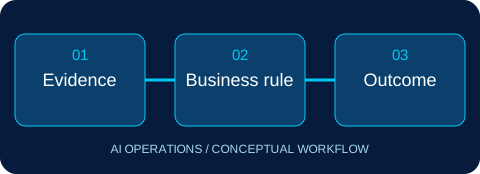
Suppose a staffing system predicts a busy service window. The model estimates demand, while a scheduling policy balances capacity, availability and service commitments. A manager then considers circumstances absent from the data. Recording those layers allows the organization to identify whether a poor result came from the forecast, the policy or missing context. Keep the identity of the approver with the decision, so responsibility remains visible after the recommendation is accepted.
A purchasing recommendation may depend on a forecast, a supplier constraint and a rule about available cash. Record those contributions separately. If the outcome disappoints, the team can examine the right layer rather than assuming that every poor result requires a different model or a larger training dataset.
Scenario comparison helps decision makers understand uncertainty. Identify which assumption drives the result and how the proposed action changes if that assumption weakens. A range of plausible outcomes is often more useful than a single precise-looking number, especially when the organization must make a commitment before all information is available.
Use scenarios when uncertainty is material. Present a range of plausible demand conditions and show how each changes the staffing requirement. Do not hide uncertainty behind a single polished recommendation. Review overrides as a learning source: they may expose a model weakness, a policy exception or a local practice that needs closer attention. Review a sample of accepted recommendations as well as overrides. Teams often investigate disagreement while assuming accepted suggestions were sound. Examining both can reveal overreliance, a misleading interface or a policy that works only under a narrow range of conditions.
Review decisions after enough time has passed to observe their consequences. Include accepted recommendations and overrides, then distinguish errors in evidence from errors in policy. The purpose is to improve the decision process. Treating every exception as disobedience can suppress information that the system needs in order to become useful.
Measure forecast quality alongside decision quality. A more accurate prediction can still produce poor outcomes if capacity constraints or business incentives are ignored. Review decisions after the fact with the people affected by them.
SOURCES & FURTHER READING / Framework: NIST AI RMF
SOFTMAG editorial analysis. Business scenarios and diagrams are explanatory examples.
CLOUD MODERNIZATION
Migration is a beginning, not an outcome.
Moving a workload to cloud infrastructure does not automatically make it resilient or economical. Modernization changes how a service is built, operated and funded. The right strategy depends on its dependencies, business importance and expected remaining life. Modernization has a human dependency map as well as a technical one. Identify who knows the batch schedule, the recovery procedure and the rarely used integration. Losing that knowledge during a migration can create avoidable surprises after the main cutover appears complete.
Find services, data stores and hidden jobs.
Assess change rate and business criticality.
Move a manageable dependency group.
Use a rehearsed and observable cutover.
Exercise complete workflows and recovery.

Original AI-assisted editorial illustration · Cloud modernization
Build an application inventory before choosing a migration pattern. Identify data stores, network dependencies and recovery requirements. A stable system with limited change may be retained; a heavily modified service may justify refactoring or replacement. Use a dependency group as the planning unit when applications share data and timing assumptions. Test the order in which components start and recover. A service can pass individual checks while the surrounding business process remains unable to complete.
A retailer might modernize product search before touching the ledger. Search can scale with demand and be released independently, while a controlled integration keeps financial records consistent. A staged approach limits the number of moving parts in each release.
Resilience requires tested behavior. Define recovery time and acceptable data loss, then rehearse restoration and dependency failure. Multiple instances do not help if all depend on one unavailable identity service or database.
Track spend per useful transaction, deployment lead time and service reliability. Include data transfer, duplicated environments and operational support in the cost comparison. Turn off old capacity only after the new path and rollback window are understood.
CLOUD MODERNIZATION / CONTINUED
Move the workload for a reason you can measure.
Different applications deserve different migration strategies. Rehosting can reduce the scope of a move but preserve existing inefficiencies. Refactoring can improve adaptability while increasing delivery risk. Replacement may simplify support yet require process change. Retiring an unused application may create more value than moving it anywhere.
An application inventory should include scheduled jobs, reporting exports, certificate renewals and the people who know how recovery works. These dependencies may not appear in the main architecture diagram. Testing them before cutover reduces the chance that a successful migration of the visible service conceals a broken business process.
Running two environments can support a safe transition, but it also introduces additional cost and reconciliation work. Define which system accepts writes at each stage and how discrepancies are resolved. Give retirement of the old environment an owner and explicit conditions, so temporary duplication does not become the permanent operating model.
Sequence migration around dependency groups and validate recovery with representative data. A service is not ready merely because the landing page responds. Check scheduled tasks, reporting, identity, downstream integrations and operational access. Keep rollback constraints visible, especially after writes begin flowing to a new data store. Capture the cost of running two environments during transition. Temporary duplication often persists when retirement has no owner. Put decommissioning conditions in the migration plan and verify that the old service is genuinely unused before removing its capacity.
The cutover is a useful milestone, rather than the end of improvement. Compare reliability, support effort and useful work per unit of spend with the previous baseline. Use that evidence to decide whether the next step is refactoring, a managed service or simply better operating discipline around the architecture already in place.

Track spend per useful transaction, deployment lead time and service reliability. Include data transfer, duplicated environments and operational support in the cost comparison. Turn off old capacity only after the new path and rollback window are understood.
SOURCES & FURTHER READING / AWS: architecture, operations and resilience
SOFTMAG editorial analysis. Business scenarios and diagrams are explanatory examples.
HYBRID & MULTI-CLOUD
Optionality has an operating cost.
Hybrid cloud combines environments with different locations and operating models. Multi-cloud adds more than one provider. Both can serve real needs, but neither is a shortcut to resilience. The design must explain which workload belongs where and why. A placement strategy is a set of decisions, not an architectural slogan. Write down the constraint each environment addresses. This makes it easier to revisit the design when connectivity, provider capabilities or the organization’s own skills change.
More platforms create more responsibilities.
Start with constraints: latency, data movement, local processing, specialized services and existing team skills. Standardize identity, policy and observability where possible. Avoid creating a separate incident process and access model for every platform. Compare failure domains carefully. Two providers can still depend on the same identity service, network route or operational team. Resilience requires understanding these shared dependencies and preparing a response that remains feasible during a real disruption.

Original AI-assisted editorial illustration · Hybrid & multi-cloud
A business may keep latency-sensitive processing near a factory while using public cloud for analytics. Only the necessary data crosses the boundary. If connectivity fails, local operations continue under defined limits and synchronize later.
Cross-cloud recovery involves more than deploying containers elsewhere. Data replication, secrets, networking and provider-specific dependencies must work together. Test whether a recovery exercise can meet the business objective with the people actually on call.
HYBRID & MULTI-CLOUD / CONTINUED
More platforms create more responsibilities.
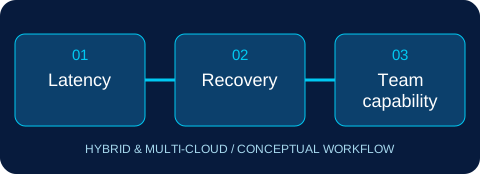
Placement decisions start with the data path. A service that repeatedly transfers large datasets may lose the expected benefit of a cheaper compute location. A factory application may depend on local operation during a network interruption. Model those paths and failure conditions before comparing the feature lists of providers.
A workload-placement diagram should show how often information crosses a boundary and what happens when that connection is interrupted. Processing near the data can sometimes matter more than a nominally cheaper instance. Include recovery traffic and routine management access in the picture, not just the application’s normal customer requests.
A consistent vocabulary for ownership, severity and access makes several environments easier to operate. It does not require every provider-specific feature to be hidden behind a common abstraction. Standardize where it reduces recurring work, while allowing justified differences that the team can document, secure and support throughout the service lifecycle.
Use one operating vocabulary across environments: owners, severity levels, service objectives and cost allocation. Platform-specific mechanisms can remain different where necessary. A common control plane is valuable only if it gives teams accurate visibility and a practical way to respond. Test cross-environment recovery instead of assuming that a portable container makes the whole system portable. For each cross-environment connection, identify the producer, consumer and data owner. Agree on freshness, retry behavior and reconciliation. These ordinary contracts often determine whether a hybrid design feels dependable to users or becomes another source of uncertainty.
Portability should be evaluated through an actual move or recovery exercise. Confirm that data, credentials and dependencies can reach the target environment within the required conditions. The exercise may show that selective portability is sufficient, leaving the organization free to use specialized capabilities where their benefit justifies the commitment.
Use portability selectively. A common interface may be worth maintaining for a critical dependency; copying every feature across providers can waste effort. Include transfer charges and the cost of maintaining skills when comparing alternatives.
SOURCES & FURTHER READING / Google Cloud: hybrid and multicloud architecture
SOFTMAG editorial analysis. Business scenarios and diagrams are explanatory examples.
CLOUD-NATIVE DELIVERY
A platform should make good delivery easier.

Original AI-assisted editorial illustration · Cloud-native delivery
Containers package an application and its dependencies into a repeatable unit. Kubernetes orchestrates workloads through declarative resources and reconciliation. DevOps adds the organizational practices that connect building, releasing and operating a service. These pieces solve different problems. A platform’s real product is the experience of delivering a service. Developers need a predictable path from source to runtime, useful defaults and a clear route for exceptions. Standardization should remove repetitive decisions while preserving the ability to solve unusual problems.
For a customer-facing service, a progressive release can expose a small share of traffic to a change. Operators compare error rates and latency before expanding. A failed health check should stop promotion rather than leave a team discovering problems through customer complaints.
A delivery pipeline should produce an artifact that can be traced to source, checked and promoted between environments. Keep configuration separate, protect credentials and make rollback understandable. Teams need visibility into runtime behavior after the deployment succeeds. Manage configuration with the same care as code. A small policy or resource change can affect availability without modifying the application artifact. Record who changed it, why it changed and how the previous state can be restored if needed.
Microservices and clusters introduce coordination work. A small team may achieve better results with a modular application on a managed platform. Choose architecture to match operating capacity, not to imitate a larger organization.
CLOUD-NATIVE DELIVERY / CONTINUED
Delivery is complete when the service works.
Commit Keep the intended change small.
Build Produce a traceable artifact.
Verify Check important behavior and dependencies.
A reproducible build is the beginning of a release record. Preserve the source revision, dependency inputs, checks and artifact identity. Promote the same artifact rather than rebuilding it differently in each environment. This makes investigation easier when a failure appears only after a release reaches real traffic.
A process can be running while a customer cannot complete a transaction. Release checks need to observe the behavior that matters to the application. Combine infrastructure signals with useful service outcomes, then make the conditions for pausing a rollout understandable to the people responsible for the release.
Rebuilding separately for each environment can make investigation harder because the inputs may differ. A traceable artifact, reviewed configuration and a clear promotion record help teams connect a running service to the intended change. These practices are useful whether the runtime is a large orchestration platform or a simpler managed application service.
Kubernetes reconciliation can maintain a declared workload state, but application health still requires careful signals. A running container is not proof that a customer can complete a task. Readiness checks, resource requests and rollout settings need to reflect application behavior. Developers and operators should agree on the symptoms that stop a release. A useful release review connects intent to runtime evidence. Inspect whether the new behavior reaches users, whether service objectives remain healthy and whether support teams understand the change. The release pipeline should make those answers easier to obtain.
A developer platform succeeds when it removes repeated work without obscuring responsibility. Ask developers where they lose time, which exceptions are difficult and whether the supported path provides useful feedback. Use those answers to improve the platform as a product, while keeping service ownership with the teams able to act on runtime evidence.
Measure change lead time, failed releases, recovery time and service objectives together. Faster deployment is useful when teams can detect and repair failures. Platform teams should treat developers as users and remove recurring friction.
SOURCES & FURTHER READING / Official documentation: Kubernetes concepts
SOFTMAG editorial analysis. Business scenarios and diagrams are explanatory examples.
CYBERSECURITY
Make defense part of everyday delivery.
A secure enterprise needs visibility into what it runs, who can access it and how it responds when something fails. Security products can support that work, but ownership and rehearsed procedures determine whether the organization can act in time. Start with the systems whose failure would interrupt essential work. A long inventory becomes actionable when it connects technical exposure to business consequence. This also helps teams explain why one issue needs immediate attention while another can enter a scheduled maintenance window.
Maintain an inventory of exposed services and critical assets. Prioritize remediation using business impact and exposure. Protect privileged accounts and make dependency review, secret detection and secure configuration part of routine delivery rather than a final gate. Security feedback should arrive where engineers can act on it. Include the affected component, the exposure and the proposed remediation path. Repeated alerts without context can create fatigue and make it harder to distinguish an urgent threat from background noise.
Original AI-assisted editorial illustration · Cybersecurity
A software team could stop a leaked credential from reaching a release, revoke it and check its use. The response matters as much as detection: a notification that no one owns can become another unattended queue.
A response plan needs people who can execute it.
Rehearse an incident using realistic constraints. Who can isolate a service? How are customers informed? Can responders reach a clean communication channel if the normal one is unavailable? A short exercise often reveals gaps that a policy document misses.
CYBERSECURITY / CONTINUED
A response plan needs people who can execute it.
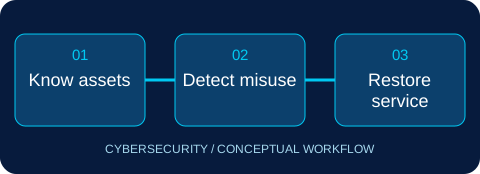
An alert creates value only when it leads to an appropriate response. Define which team owns the affected asset, how severity is assessed and what evidence is needed to act. A small number of actionable detections can be more useful than a large volume of notifications that nobody has time to inspect.
Detection is only one part of a security capability. Each important alert should connect to a current owner, a severity decision and a practical response procedure. Without those links, more notifications can increase fatigue while leaving the organization no better prepared to contain the incident that actually matters.
Incident exercises should consider the loss of normal collaboration tools. Responders may need clean contact lists, alternative communication and access to recovery instructions. A short scenario can expose missing authority or inaccessible records. Assign an owner to each improvement so the next exercise does not rediscover the same avoidable obstacle.
Prepare for communication under pressure. Responders need access to current contacts, asset records and recovery instructions even when the normal collaboration platform is unavailable. Practice a short scenario involving a stolen credential or exposed service. Capture the missing information and revise the procedure while the exercise is still fresh. After an incident exercise, assign an owner and review date to each improvement. Otherwise the same missing contact or inaccessible recovery guide may appear in the next rehearsal. Small, completed fixes build more confidence than an ambitious plan nobody can maintain.
Review recurring causes alongside individual incidents. A repeated credential leak or configuration mistake may indicate a weak delivery path rather than a need for another reminder. Improving defaults, access patterns and feedback can make secure behavior easier to sustain, while preserving the team’s ability to investigate the unusual cases that remain.
Track the age of serious exposures, time to contain incidents and restore success. Pair technical metrics with evidence that teams know their roles. Prioritization should reduce meaningful risk rather than simply increase the number of closed tickets.
SOURCES & FURTHER READING / NIST Cybersecurity Framework
SOFTMAG editorial analysis. Business scenarios and diagrams are explanatory examples.
ZERO TRUST
Authorize the request, not the location.

Original AI-assisted editorial illustration · Zero trust
A request should not receive broad access simply because it originates inside a corporate network. Zero trust makes identity, device condition and resource sensitivity part of an explicit access decision. It is an architectural approach that develops over time. Network location is a useful signal but a weak substitute for resource-specific permission. Employees, contractors and service accounts have different needs. Start with those needs, then limit the duration and breadth of access that each workflow actually requires.
Start with the resources that matter most. Map users, service identities and their actual permissions. Strong authentication helps establish identity; authorization determines which action that identity may perform. Short-lived privileges reduce the duration of unnecessary access. Policy needs an exception process that people can understand. Temporary access should have a stated purpose, an accountable approver and an expiry. A policy that makes legitimate work impossible can drive users toward hidden channels with weaker oversight.
A contractor supporting one application can receive access to that application for the duration of the engagement. The policy can require a managed device and restrict sensitive operations without opening a broad network path.
Service-to-service traffic also needs identity and policy. Rotating credentials, workload identities and segmented access can limit the effect of a compromised service. Logging must support investigation without collecting unnecessary sensitive information.
Trust is an explicit decision about a request.
Review access decisions and remove unused permissions. Roll out policy changes with monitoring so legitimate work is not silently blocked. CISA’s maturity model provides a reference for assessing progress across identity, devices, networks, applications and data.
ZERO TRUST / CONTINUED
Trust is an explicit decision about a request.
Knowing who made a request is necessary but insufficient. The policy also needs to determine whether the requested action is appropriate for that identity, device and resource. Broad group memberships often persist after projects end. Review the permissions that are actually used and remove access that has no current purpose.
Project access often remains after the work has ended. Review identities against current tasks and named owners, including service accounts and integrations. Removing unnecessary access is easier to justify when the organization understands the purpose behind each permission, rather than treating a large collection of historical group memberships as its policy.
Temporary access should identify the resource, the action, the approver and the duration. Make the exception route practical enough that people can use it for legitimate work. A policy that blocks essential tasks without a clear resolution path can encourage informal workarounds and leave administrators with less visibility into actual behavior.
Introduce new policies with visibility into blocked and permitted requests. A sudden blanket change can interrupt essential workflows and encourage workarounds. Use a staged rollout, provide a documented exception path and put an expiry on temporary access. Workload identities deserve the same attention as employee accounts. Inspect dormant service accounts and integrations as well as human users. Credentials can outlive the applications that created them. Access review should connect every active identity to a present owner, a continuing purpose and the resources it is permitted to use.
Zero trust develops through repeated review of real requests and resource needs. Introduce controls with enough monitoring to understand their effect, investigate unexpected denials and remove unused privileges. The goal is an access model that remains explainable as people, devices and applications change, rather than a one-time claim that the network is trusted.
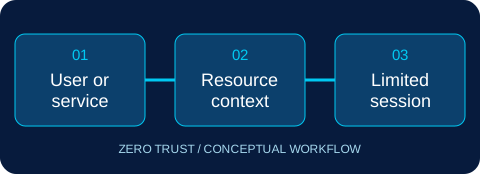
Review access decisions and remove unused permissions. Roll out policy changes with monitoring so legitimate work is not silently blocked. CISA’s maturity model provides a reference for assessing progress across identity, devices, networks, applications and data.
SOURCES & FURTHER READING / Framework: CISA Zero Trust Maturity Model
SOFTMAG editorial analysis. Business scenarios and diagrams are explanatory examples.
PRIVACY & RESILIENCE
Collect less. Recover with confidence.

Original AI-assisted editorial illustration · Privacy & resilience
Privacy begins before a database is created. Teams should know why information is needed, who will use it and when it can be deleted. Resilience adds a second question: can essential services continue when systems or data become unavailable? Data minimization can simplify operations as well as reduce exposure. Fewer copies mean fewer access rules, retention jobs and recovery questions to manage. Start by challenging exports and fields that persist simply because they were easy to add.
Map personal information across applications, exports and third-party integrations. Minimize duplicate copies and make permissions reflect purpose. A deletion request is only complete when connected systems and retention rules have been considered. Make purpose visible in interfaces and integrations. A support role may need contact details for one case without needing a bulk customer export. Designing around actual tasks helps permissions follow business need rather than broad departmental membership.
A customer-service platform can keep a durable case identifier while restricting access to identifying details. Analysts may need patterns rather than names. This separation reduces unnecessary exposure while preserving operational usefulness.
A backup becomes resilience through a tested restore.
Recovery requires protected copies and tested procedures. Establish how much data loss is acceptable and how quickly service must return. Run restoration exercises in an isolated environment and verify that recovered applications can process real workflows.
PRIVACY & RESILIENCE / CONTINUED
A backup becomes resilience through a tested restore.
A record can leave its originating application through exports, logs, analytics and support attachments. Create a data map that includes these secondary paths. Retention and deletion are difficult to enforce when teams cannot locate copies. Restrict sensitive fields in logs and separate identifiers from routine analysis where practical. Review emergency access after a recovery exercise as well as after a real incident. Temporary privileges and restored exports should return to their normal lifecycle, rather than remaining as undocumented exceptions.
Personal information can travel through exports, analytics, support attachments and application logs. Include those paths in the inventory. A carefully designed main application cannot fully control exposure if secondary copies retain broad access or an unclear purpose. Reducing unnecessary duplication also makes retention, correction and recovery decisions easier to operate.
A protected recovery copy serves a different purpose from a live customer record. Teams need an agreed way to apply lifecycle rules when data is restored. Test the process rather than assuming it will happen automatically, and include the credentials, keys and dependent services needed to make the recovered information usable.
Resilience also has a data lifecycle. Recovery copies must be protected from the same failure that affects production, and restoration needs validation beyond a successful file transfer. Test whether identities, keys and dependent applications can use the recovered information. Review emergency access after the incident and remove temporary privileges. Run deletion and restoration tests as different exercises. A recovery mechanism should not accidentally reintroduce information that a valid retention process removed. The responsible teams need an agreed approach to reconciling lifecycle rules with protected recovery copies.
Trust grows when people can understand what is collected, why it is used and how problems are handled. Connect the inventory to operational responsibilities and review exceptions with the relevant specialists. Privacy and resilience then become characteristics of the service, supported by evidence from real lifecycle and restoration exercises.

Identity connects privacy and resilience. Protect recovery credentials, review emergency access and revoke temporary privileges afterward. Specific legal obligations depend on jurisdiction and context; an operational inventory helps the responsible specialists evaluate them.
SOURCES & FURTHER READING / NIST Privacy Framework
SOFTMAG editorial analysis. Business scenarios and diagrams are explanatory examples.
GREEN SOFTWARE
Make resource use an engineering decision.
Software influences how much computation runs, how long data remains and how frequently hardware needs replacement. Sustainable engineering makes those choices visible. A smaller environmental footprint often begins with removing work that produces no useful outcome. Efficiency belongs in the product conversation too. An automatic refresh, high-resolution preview or indefinite history can have a resource cost that is invisible to the user. Offer sensible defaults and evaluate whether the feature’s useful value justifies its continuing demand.
Original AI-assisted editorial illustration · Green software
Measure a consistent boundary before optimizing. Include operational energy and consider the hardware supporting the application. The Green Software Foundation’s SCI approach relates operational and embodied emissions to a functional unit, such as a completed transaction. Use measurement to guide investigation rather than claim certainty beyond the evidence. Energy estimates, regional signals and hardware allocations can contain assumptions. State them, keep them consistent and show which engineering change produced the observed difference.
A reporting system might repeatedly rebuild an unchanged dataset. Incremental updates, sensible caching and shorter retention for unused outputs can reduce processing. Confirm that cache invalidation and retention changes preserve the business behavior users depend on.
Scheduling flexible jobs for lower-carbon periods may help when reliable regional signals and workload flexibility are available. It cannot replace efficiency. Moving work across regions also introduces latency, transfer and data-location considerations.
Track absolute resource use alongside efficiency per transaction. A more efficient service may grow enough to consume more overall. Explain measurement assumptions and compare like-for-like workloads so improvements are credible rather than cosmetic.
GREEN SOFTWARE / CONTINUED
Count useful work, and count the resources behind it.

A functional unit makes an efficiency discussion concrete. It might be a completed transaction, a report generated or a useful computation. Keep the system boundary and assumptions stable when comparing versions. Otherwise an apparent improvement may simply move energy use outside the part being measured.
Engineering choices are influenced by product expectations. An automatic refresh, high-resolution preview or indefinite history can create continuing resource use. Examine whether the behavior serves a clear user need and whether a more deliberate default would preserve the benefit. Sustainability can begin with deciding which work should not be requested.
A credible efficiency comparison keeps the workload, completion criteria and system boundary understandable. Record the assumptions behind estimates and note where resource use has moved to another component. This allows the team to distinguish a real reduction from a change in scope, or from shifting work onto a device that was not being measured.
Optimization can begin with ordinary engineering: avoid repeated queries, reduce unused data transfers and turn off idle environments. Assess the effect on correctness and performance. A smaller payload that requires expensive decoding on every client may move work rather than remove it. Review total demand as well as efficiency per unit. In a review, compare identical work under comparable conditions. Record dataset size, completion criteria and the components included. This makes a smaller resource footprint credible and helps the team distinguish a genuine efficiency improvement from a change in scope.
Choose an owner for resource measurements and review them alongside service quality. A lower consumption figure is useful only if the application still performs its intended function. Track absolute demand as well as efficiency per useful unit, then explain the engineering or product changes responsible for the result.
Track absolute resource use alongside efficiency per transaction. A more efficient service may grow enough to consume more overall. Explain measurement assumptions and compare like-for-like workloads so improvements are credible rather than cosmetic.
SOURCES & FURTHER READING / Methodology: Software Carbon Intensity specification
SOFTMAG editorial analysis. Business scenarios and diagrams are explanatory examples.
EFFICIENT INFRASTRUCTURE
The quiet opportunity is unused capacity.

Original AI-assisted editorial illustration · Efficient infrastructure
Data-center sustainability is shaped by power, cooling, hardware and the workloads placed on that hardware. Application teams influence utilization and demand even when they do not operate the facility. Procurement and engineering therefore need a shared view of efficiency. Infrastructure efficiency depends on useful demand. An application that issues fewer redundant jobs can reduce the capacity required across several layers. This makes software teams participants in resource planning even when a specialist provider operates the physical facility.
Begin with idle virtual machines, oversized memory reservations and repeated background work. Right-sizing must preserve headroom for peaks and failure recovery. Monitor actual behavior over a representative period before reducing capacity. Review reservations and retention against observed behavior. Keep the headroom needed for recovery, but challenge allocations with no current owner or purpose. An explicit capacity decision is easier to defend than a permanent margin nobody remembers setting.
A batch-processing platform can queue flexible jobs to consolidate work rather than keeping many machines lightly loaded. Cold storage policies can move rarely used data to a suitable tier, provided retrieval times still meet business requirements.
Facility efficiency ratios describe part of the picture. Regional electricity, water use and hardware production also matter. Ask suppliers for clear measurement boundaries and avoid treating one number as a complete environmental assessment.
The cleanest capacity is often the capacity never needed.
Extend useful hardware life where performance and support permit. Compare replacements against the workload’s real needs. Report both demand reduction and infrastructure efficiency so a team can see whether savings survive growth.
EFFICIENT INFRASTRUCTURE / CONTINUED
The cleanest capacity is often the capacity never needed.
Application architecture affects utilization, which affects the capacity a facility must supply. Underused instances, duplicated data and inflexible scheduling can create demand that efficient cooling cannot remove. Engineering and infrastructure teams should review resource patterns together instead of treating sustainability as a facilities-only concern.
Facilities teams can improve power and cooling, while application teams influence how much capacity is needed. Review workload patterns together. Underused reservations, duplicate processing and unmanaged storage can preserve demand that efficient infrastructure alone cannot remove. A shared picture helps investment decisions address the cause as well as the physical consequence.
Right-sizing should use representative demand and a clear recovery requirement. Capacity needed during a failure is different from an allocation that has simply lost its owner. Record the reason for retained headroom and test the conditions it supports, so future optimization does not remove resilience through an incomplete understanding of normal utilization.
Capacity changes need a safety margin grounded in observed demand. Reclaim idle allocations but account for peaks, recovery and maintenance. Procurement decisions should include expected hardware life, supportability and the actual workload. A newer system is not automatically the best environmental choice if existing equipment can safely remain useful. Discuss replacement decisions across procurement, operations and engineering. A workload may benefit from new hardware, or it may run safely on existing equipment. Compare expected useful life, support constraints and actual demand before assuming replacement is the best route.
Hardware decisions need context about support, performance and continuing demand. A replacement may improve the workload, or existing equipment may remain a sound choice. Include the expected service life and the effort required to migrate or maintain it. A single facility ratio cannot answer every question about the environmental consequences of computing.
Extend useful hardware life where performance and support permit. Compare replacements against the workload’s real needs. Report both demand reduction and infrastructure efficiency so a team can see whether savings survive growth.
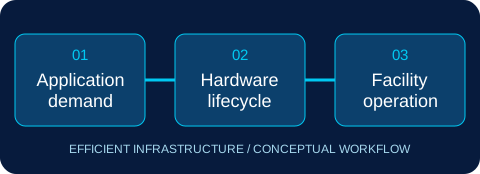
SOURCES & FURTHER READING / Methodology: Software Carbon Intensity specification
SOFTMAG editorial analysis. Business scenarios and diagrams are explanatory examples.
LOW-CODE
Speed needs a path to production.

Original AI-assisted editorial illustration · Low-code
Low-code platforms turn common application patterns into reusable components. Forms, rules and connectors can shorten the distance between a business need and a working tool. The benefit lasts only when the application can be supported, secured and changed safely. A visual application still expresses a data model and a set of business rules. Errors in those choices can be as consequential as errors in handwritten code. The platform removes some assembly work; it does not remove the need to understand the process.
Provide approved connectors and data-access policies before teams improvise their own integrations. Separate development and production environments. Changes to workflow logic should be reviewed and tested, especially when they affect money, access or customer records. Test connectors under failure, not just successful submission. Consider expired credentials, partial updates and duplicate requests. The person using the form should know whether the operation completed and how to recover without creating another inconsistent record.
An inspection team could build a mobile checklist that validates required evidence and routes exceptions. Approved results update the central system. A useful pilot includes offline behavior, duplicate submissions and a clear owner for rejected records.
Review licensing and platform limits early. A prototype can become expensive when usage expands or premium integrations are added. Understand export options and what would be required to rebuild a critical process elsewhere.
Fast assembly still needs sound engineering.
Evaluate delivery speed together with reliability, support hours and the volume of manual correction. Establish a threshold at which a departmental app needs formal engineering support. Fast development should not create invisible long-term obligations.
LOW-CODE / CONTINUED
Fast assembly still needs sound engineering.
A low-code prototype can look complete while important behavior remains untested. Consider who can change rules, how failed connector calls are retried and whether a deployment can be reversed. Export configuration where the platform permits it and preserve a record of reviewed changes.
A low-code application expresses data structures, rules and authority even when its builder writes little conventional code. Make those choices reviewable. A form that looks complete may still mishandle an expired credential, an unexpected approval sequence or a request that succeeds only partly across connected systems.
Users need to know whether a submission completed and what to do next. Connector retries and duplicate requests should be tested with the same care as the successful path. Helpful recovery behavior can prevent a small integration fault from creating inconsistent records or forcing staff to repeat work without knowing its original outcome.
A business-critical workflow needs environments, access roles and a support procedure. Define the point at which an app requires engineering assistance: handling sensitive data, connecting several systems or processing consequential approvals are useful triggers. Governance works best when it provides a clear route forward instead of only a list of restrictions. Set an application retirement policy alongside the launch process. When a workflow changes, an old app can continue collecting data unnoticed. A current owner should periodically confirm the need, dependencies and support route, then retire redundant tools deliberately.
Set a clear threshold for additional review when an application handles sensitive information, consequential approvals or several dependencies. Offer engineering help at that point and keep ownership visible. Low-code delivery becomes sustainable when a successful prototype can progress into a service the organization is genuinely prepared to support.

Evaluate delivery speed together with reliability, support hours and the volume of manual correction. Establish a threshold at which a departmental app needs formal engineering support. Fast development should not create invisible long-term obligations.
SOURCES & FURTHER READING / Appsmith: widgets, data connections and business logic
SOFTMAG editorial analysis. Business scenarios and diagrams are explanatory examples.
CITIZEN DEVELOPMENT
Give process experts tools and support.
Citizen developers understand the exceptions that formal requirements often miss. No-code tools let them turn that knowledge into workflows without writing a conventional application. The goal is supported participation, with clear boundaries around sensitive data and consequential actions. The strongest citizen-development programs make good examples easy to reuse. A builder should not need to invent access roles, error messages and approval records for every new workflow. Supported patterns let process expertise concentrate on the part that is genuinely different.

Original AI-assisted editorial illustration · Citizen development
A people-operations team might build an onboarding checklist that tracks task completion while leaving sensitive records in the approved system. Managers see the status they need without receiving unnecessary personal information.
Create a catalog of approved templates, connectors and examples. Teach builders how to model data, test edge cases and name an owner. A searchable application register prevents multiple teams from quietly solving the same problem in incompatible ways. Give builders a safe environment for experimentation. Use representative test information and make it clear when an application is ready for real users. This protects both the people learning the platform and the colleagues who may later depend on their work.
Creates and tests the workflow.
Confirms purpose and ongoing need.
Provides safe tools and technical support.
Reviews appropriate information use.
Empowerment lasts when the support lasts.
A successful tool can outlive its creator’s role. Document dependencies, access and support contacts before the application becomes indispensable. Provide a route to transfer ownership or retire the tool when circumstances change.
Measure useful adoption, completion rates and support load. Celebrate improvements that remove work, but review sprawling automation chains that are difficult to diagnose. A small center of enablement can help builders resolve common problems without taking every task away from them.
CITIZEN DEVELOPMENT / CONTINUED
Empowerment lasts when the support lasts.
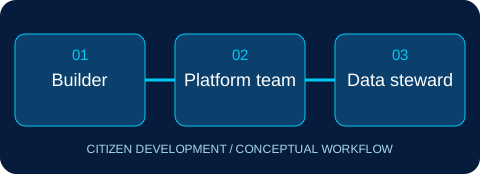
No-code tools bring application building closer to the people who understand a process. Give those builders practical boundaries: approved data sources, reusable patterns and a clear way to ask for help. A searchable app register should describe purpose, owner, users and dependencies in plain language.
Approved templates can demonstrate sound input validation, access roles and exception handling. Builders then concentrate on the process detail that differs, rather than inventing every component again. Provide a safe environment for experimentation and a clear route from learning exercises to an application that is ready for real users.
A useful departmental tool may survive the role of the person who created it. Preserve its purpose, dependencies and support contacts in a register, then make transfer or retirement part of normal governance. This protects both the builder and the colleagues who may come to rely on the workflow.
Support the whole lifecycle. A useful application may need transfer when its creator moves roles, changes when an API evolves and retirement when the process disappears. Provide examples of these transitions in training. Review integrations that grow into long chains, because a failure near the beginning can be difficult to diagnose at the end. Review the register periodically with business owners. Look for duplicated tools, unused connections and apps that have quietly become essential. The review is an opportunity to offer support and simplify the landscape, rather than discourage useful local problem-solving.
Periodic reviews can identify duplicated applications, unused connections and tools that need more formal support. Treat the review as an opportunity to offer help and reduce complexity. Citizen development is strongest when process expertise and technical stewardship work together, with a shared understanding of what the organization can safely maintain.
Measure useful adoption, completion rates and support load. Celebrate improvements that remove work, but review sprawling automation chains that are difficult to diagnose. A small center of enablement can help builders resolve common problems without taking every task away from them.
SOURCES & FURTHER READING / Microsoft: professional and citizen developer adoption
SOFTMAG editorial analysis. Business scenarios and diagrams are explanatory examples.
AR / VR
Use immersion where context matters.

Original AI-assisted editorial illustration · AR / VR
Immersive technology earns its place when scale, movement or physical surroundings are central to a task. Training, design reviews and remote assistance can benefit from a shared sense of space. A headset is a means to a better outcome, not the outcome itself. A useful immersive experience reduces a specific learning barrier. It may make an inaccessible environment available or allow safe repetition of a rare event. Decide which barrier matters before spending effort on visual detail that does not contribute to the task.
Choose a task that is costly, dangerous or difficult to repeat physically. Define how success will be tested: fewer errors, better recall or less time to competence. Compare against the training method already in use. Plan the session around the user’s comfort and attention. Instruction, device adjustment and a clear exit route belong in the experience. Participants should be able to stop without losing progress or feeling pressured to continue through discomfort.
A maintenance team could rehearse a complex procedure in a virtual environment before approaching live equipment. The simulation can expose rare failure conditions safely. It still needs validation by experienced technicians and a clear link to real procedures.
Immersion is valuable when learning leaves the headset.
Comfort, accessibility and hygiene affect adoption. Provide alternative learning routes, allow breaks and test with a range of users. Device management, content updates and physical room safety belong in the operating plan.
AR / VR / CONTINUED
Immersion is valuable when learning leaves the headset.
Objective Define the skill to be learned.
Simulation Represent the relevant task conditions.
Practice Give feedback without unsafe consequences.
A training simulation needs a learning objective, not just a realistic scene. Decide what a participant should recognize or perform afterward. Separate familiarity with the headset from mastery of the task. Include an assessment outside the simulation to test whether learning transfers to the real environment.
A simulation is especially useful when a real environment is difficult, expensive or unsafe to repeat. Identify the skill or recognition task it will improve before investing in visual detail. A convincing scene is not enough: the experience needs a clear connection to the behavior a participant must perform afterward.
Separate familiarity with the device from mastery of the task. Include an appropriate assessment outside the immersive session and consider retained understanding after time has passed. Experienced practitioners should help define what successful transfer looks like, so a high engagement score does not become a substitute for evidence of practical learning.
Content maintenance matters as much as initial production. An outdated procedure can train the wrong behavior with convincing realism. Assign a subject-matter owner and review the simulation when equipment, safety instructions or working practices change. Provide a conventional alternative for users who cannot comfortably use the device. Measure retained understanding after a suitable interval and compare it with the previous method. Immediate confidence can differ from durable skill. Involve the people responsible for real-world performance so the assessment reflects what participants must actually do.
Procedures, equipment and working conditions change. Give the simulation a subject-matter owner and a review trigger, and provide a conventional alternative for users who cannot comfortably use it. The continuing value of immersion depends on accurate content and accessible delivery as much as the quality of the original production.
Keep the pilot narrow enough to update. A visually impressive simulation can become misleading when machinery or procedures change. Assign ownership for accuracy and measure retained learning after the session, not just initial enthusiasm.
SOURCES & FURTHER READING / Further reading: W3C XR accessibility requirements
SOFTMAG editorial analysis. Business scenarios and diagrams are explanatory examples.
SPATIAL COMPUTING
Design for the room around the interface.
Spatial computing places digital objects in relation to a physical environment. Its strength is contextual understanding: a model can be examined at scale or instructions can appear near the relevant component. That also makes interface mistakes physically consequential. The physical setting becomes part of the interface. A bright workspace, a confined room or a seated user can change what is comfortable and readable. Prototype in representative conditions instead of evaluating only in the room where the demonstration was built.
Digital confidence must match physical accuracy.

Original AI-assisted editorial illustration · Spatial computing
Anchor content where users expect it and preserve legibility as distance changes. Do not place essential information outside a comfortable field of view. Offer alternatives to gestures and avoid assuming every user can stand, move freely or wear the same device. Use spatial placement to reveal a relationship that a flat screen hides. If the task is primarily reading a long document, a conventional display may be more effective. Context should earn the extra interaction and equipment required.
An architecture team could inspect a full-scale layout before construction. Shared annotations identify access problems and equipment clearances. The review becomes useful when decisions and measurements can be captured and returned to the design record.
Tracking can fail under changing light or in featureless spaces. Define graceful behavior when anchors drift. Users should know when an overlay is uncertain rather than treating every visual element as a precise measurement.
SPATIAL COMPUTING / CONTINUED
Digital confidence must match physical accuracy.

A spatial interface depends on sensing and tracking that can become uncertain. Lighting changes, reflective surfaces and movement can affect placement. Make uncertain states understandable. A user should know when a label is a contextual hint rather than an accurate physical measurement. Make the confidence of a spatial placement understandable to the person using it.
Lighting, reflections, physical space and the user’s posture can change a spatial experience. Test in representative environments and with different interaction needs. Content that is easy to manipulate in a demonstration room may be difficult to read or reach when the same interface enters the setting where useful work actually occurs.
A spatial anchor can drift or become unavailable. The interface should communicate when content is approximate and provide a comprehensible fallback. Users need an appropriate way to confirm important dimensions or instructions, rather than assuming that a stable-looking overlay is always a precise representation of the physical object in front of them.
Test reach, viewing distance and interaction while seated as well as standing. Avoid essential controls that require prolonged arm elevation or precise gestures. Shared experiences need clear ownership of annotations and a way to return decisions to the team’s normal records. Physical context should improve comprehension, not make information harder to retrieve later. Create an explicit uncertainty state for tracking and measurement. A stable-looking overlay can invite misplaced confidence. Communicate when content is approximate and give users a way to confirm important dimensions through an appropriate independent method.
An immersive review becomes more valuable when its decisions and annotations return to the team’s normal records. Agree on ownership and the meaning of any captured measurement. This helps a spatial tool improve collaboration without creating another isolated place where important information is difficult for colleagues to find and verify.
Sensors can capture private surroundings and bystanders. Minimize recording, explain what is retained and control sharing. Evaluate task performance and comfort alongside tracking stability before making spatial interaction the default.
SOURCES & FURTHER READING / Further reading: W3C XR accessibility requirements
SOFTMAG editorial analysis. Business scenarios and diagrams are explanatory examples.
FUTURE OF WORK
Design coordination around human attention.
Hybrid work changes how teams discover information, build relationships and make decisions. A calendar full of calls can hide unclear ownership just as easily as a quiet office can. The operating model needs explicit choices about what requires shared time. Fair access to information is a management responsibility. A decision made in an informal office conversation should reach colleagues who were not present. Shared records make participation possible without requiring everyone to attend every interaction.
Document decisions in a place colleagues can find and understand. Distinguish an update from a discussion and a discussion from a decision. Set response expectations so asynchronous work does not become a demand for constant availability. Plan shared time deliberately. Teams can agree on a limited overlap window, rotate inconvenient meetings where needed and protect uninterrupted work outside those commitments. Expectations should reflect the task and customer need rather than an assumption of permanent availability.
A distributed product team might use a brief written proposal before a meeting. Participants contribute across time zones, the meeting resolves contested points and a decision record captures the outcome. New colleagues can then understand the reasoning.
Original AI-assisted editorial illustration · Future of work
Workplace tools should support accessibility and different working conditions. Offer captions, readable documents and predictable meeting windows. Managers need training in evaluating outcomes without relying on visible activity as a substitute for contribution.
Track delivery quality, coordination delays and employee feedback. Excessive monitoring can undermine trust while measuring the wrong things. Review which meetings help people decide and which can be replaced with clearer documentation.
Human-centered work protects attention and understanding.
FUTURE OF WORK / CONTINUED
Human-centered work protects attention and understanding.
An effective working agreement states where decisions live, how quickly different messages need a response and when people can expect uninterrupted time. It should distinguish an urgent operational incident from routine collaboration. Without that distinction, every notification can become an interruption.
Distinguish information that people can inspect independently from a discussion that needs rapid exchange. A readable proposal can prepare a decision before participants meet, while a short record afterward helps absent colleagues understand the outcome. Shared time becomes more useful when its purpose is explicit and the necessary context is available.
Access to information should not depend on being present during an informal conversation. Publish decisions in an agreed location, provide accessible formats and set response expectations that distinguish an urgent incident from routine collaboration. These practices help people contribute across working conditions without requiring every message to become an immediate interruption.
Choose synchronous time for disagreement, relationship building and decisions that benefit from rapid exchange. Use written updates for information that people can inspect independently. Record outcomes after the conversation, including the unresolved issues. New colleagues and absent participants should be able to understand the decision without reconstructing private messages. Review the working agreement when the team changes. New roles, customer commitments or time zones may require a different pattern. Ask which practices help people contribute and which merely reproduce habits inherited from an earlier way of working.
A team’s coordination needs change with its roles, customers and time zones. Ask which practices improve understanding and which create unnecessary effort. Evaluate delivery quality and employee feedback together. A human-centered model gives people clear commitments and the attention needed to meet them, rather than equating constant visibility with meaningful contribution.

Track delivery quality, coordination delays and employee feedback. Excessive monitoring can undermine trust while measuring the wrong things. Review which meetings help people decide and which can be replaced with clearer documentation.
SOURCES & FURTHER READING / Further reading: W3C accessibility fundamentals
SOFTMAG editorial analysis. Business scenarios and diagrams are explanatory examples.
AI COLLABORATION
Make knowledge easier to verify.

Original AI-assisted editorial illustration · AI collaboration
AI assistants can draft, summarize and retrieve, but collaboration depends on shared understanding rather than fluent output. A useful assistant helps people find evidence and clarify commitments. It should make uncertainty visible instead of smoothing it away. An assistant’s output becomes useful when a team can verify and adopt it with reasonable effort. Drafts should preserve the distinction between recorded facts, suggestions and uncertain interpretations. This reduces the risk that polished language quietly changes the meaning of a discussion.
Connect approved information sources and preserve their access controls. Retrieval should not reveal a restricted document through a summary. Show source links and timestamps so readers can judge whether information is current and relevant. Permission design must extend through retrieval, generation and sharing. A user should not gain access to restricted material simply because the system can summarize it. Confirm that citations and generated extracts obey the same information boundaries as their source documents.
A project manager could convert a meeting transcript into proposed actions. Participants confirm owners and deadlines before the list enters the project system. Disagreements and unresolved questions remain visible rather than being turned into a false consensus.
Shared understanding is more valuable than polished wording.
Evaluate assistants using realistic team tasks. Check omissions, attribution and whether cited material actually supports the answer. Include ambiguous discussions and conflicting documents, not just clean examples designed for a demonstration.
AI COLLABORATION / CONTINUED
Shared understanding is more valuable than polished wording.
Meetings often contain tentative ideas, competing proposals and uncertain commitments. A summary that turns all of them into confident action items can create confusion. Ask an assistant to distinguish decisions, proposed actions and unresolved questions. Let participants confirm consequential commitments before the output becomes authoritative. The review should include documents that disagree. A useful assistant can identify the conflict and point to its sources, leaving the team with a clear question to resolve rather than an invented consensus.
A meeting can contain decisions, suggestions and unresolved disagreements. A summary should keep those categories distinct. Turning every tentative remark into a confident action item can change the meaning of the conversation. Ask participants to confirm consequential commitments before they become authoritative tasks in another system.
Knowledge assistance should make its supporting record easy to inspect. A fluent answer may rely on an outdated document or omit a qualification that matters to the team. Review permission boundaries, source freshness and whether the citation genuinely supports the statement, including when the answer is copied into a shared workspace.
Knowledge retrieval needs permission boundaries and source context. An answer should point to the record supporting it, including whether the material is current or superseded. Review samples for omissions and misleading attribution. Track the time required to verify outputs so claimed productivity improvements include the human work that remains. Treat corrections as structured feedback. Record whether the problem was an outdated source, a missed qualification or an incorrect interpretation. Those causes call for different changes, and a single thumbs-down signal rarely explains enough to improve a collaboration workflow.
Time saved should include the effort required to verify and correct the output. Capture why an error occurred, whether through retrieval, missing context or interpretation. These causes point to different improvements. A useful collaboration tool reduces the cost of reaching shared understanding, rather than simply increasing the volume of polished text available to review.

Measure time saved after review effort is included. Good templates, clear source documents and permission hygiene often matter as much as the model. Keep a straightforward way to correct an answer and report recurring problems.
SOURCES & FURTHER READING / Framework: NIST AI RMF
SOFTMAG editorial analysis. Business scenarios and diagrams are explanatory examples.
2026 WATCHLIST
Ten signals for a focused technology agenda.
01 / WATCHLIST
Bound tasks, tools and authority before increasing autonomy. Start with a task whose completion can be independently checked. Read-only discovery and a prepared action often create value before broader execution is justified.
02 / WATCHLIST
Tie a prediction to an operational action and evaluate errors. A forecast, ranking or anomaly alert should fit available review capacity. Compare it with a simple baseline and monitor performance when operating conditions change.
03 / WATCHLIST
Remove repeated delivery work through supported paths. Treat developers as platform users. Make the ordinary path dependable, document the exception route and measure whether teams spend less time on repeated setup.
04 / WATCHLIST
Connect spend to services, owners and useful business units. Include storage, data movement, idle environments and support in the comparison. A lower instance price does not necessarily produce a lower cost per useful transaction.
05 / WATCHLIST
Make identity and context part of explicit access decisions. Review service accounts alongside employee identities. Access should have a current owner, an appropriate scope and a clear reason to remain active.
06 / WATCHLIST
Give critical data definitions, owners and quality expectations. Quality and freshness are operational commitments. Consumers need to know which system is authoritative and how to resolve conflicting or late-arriving records.
07 / WATCHLIST
Measure useful work alongside total resource consumption. Remove redundant computation and unused capacity first. Compare versions with consistent assumptions and check whether overall consumption rises despite improved efficiency.
08 / WATCHLIST
Design contracts that let systems evolve independently. Version interfaces deliberately and make failure behavior understandable. Stable contracts let a team change an implementation without forcing every consumer to move at once.
09 / WATCHLIST
Use physical context where it improves task performance. Test tracking, comfort and accessibility in representative environments. Physical context earns its place when it improves understanding or task performance.
10 / WATCHLIST
Protect attention, accessibility and shared understanding. Choose shared time for decisions that benefit from conversation. Preserve outcomes in accessible records so information is available beyond the room or meeting.
SOFTMAG editorial selection for 2026. A planning framework, not a market ranking or adoption forecast.
2026 WATCHLIST / CONTINUED
Strategy is the discipline of deciding what comes next.


Evaluate a technology theme through four questions: does it solve a meaningful problem, is the organization ready, can its value be tested and can the commitment be reversed? A trend with strong potential may still be premature for a team without the data, skills or operating capacity to use it.
Use the watchlist to identify a manageable sequence of experiments. A theme can be important without being the immediate priority for every organization. Record the problem, the capability required and the assumptions that need testing. That makes it easier to compare opportunities without treating fashionable terminology as evidence of business fit.
An experiment needs a review date and a stopping condition as well as a success measure. The outcome may justify expansion, a different approach or ending the work. Preserve that learning so the next discussion starts with evidence. A selective agenda protects specialist capacity for the initiatives the organization can actually operate.
Give each experiment a sponsor, a bounded scope and a review date. Decide in advance what evidence supports expansion, another iteration or stopping. The watchlist on the facing page is an editorial framework, not a prediction of universal adoption. Use it to start a selective discussion rather than justify every item in a budget. Revisit the watchlist periodically and record why priorities changed. A new constraint or learning from a pilot may alter the sequence. That is useful strategic feedback, provided the organization can distinguish a reasoned adjustment from simply following a new headline.
Review readiness alongside potential value: ownership, data quality, integration and support all affect the result. The most useful next step may strengthen a foundation rather than introduce a new interface. A coherent technology strategy connects those investments, allowing teams to explain why the chosen sequence serves customers and builds capability.
Score themes against customer value, evidence, team capacity and reversibility. Set a decision date for every experiment and record what would justify stopping. A strong technology agenda leaves room for learning without requiring every pilot to become a program.
SOURCES & FURTHER READING / Further reading: NIST AI RMF
SOFTMAG editorial analysis. Business scenarios and diagrams are explanatory examples.
STARTUP SPOTLIGHT
Three approaches to building software people can use.
Language access, operational tools and backend foundations each create opportunities for focused software businesses. These profiles examine three practical approaches, followed by the questions an enterprise should ask before adoption.

Original AI-assisted editorial illustration · Startup spotlight
Sarvam-M research, published in May 2025, examines post-training and inference optimization for an Indic-focused language model. The wider lesson is that language and task context are product requirements. Evaluate terminology, local examples and the cost of errors in the workflow that matters to your users.
Appsmith’s open-source tool brings widgets, database and API connections, queries and JavaScript together for internal application development. Its value lies in shortening familiar assembly work. An enterprise still needs access policies, reviewed changes and a support owner when a useful departmental tool becomes important infrastructure.
Supabase documents a PostgreSQL database alongside authentication, storage, realtime capabilities and server-side functions. These components can support a product team building its own experience. Choosing a managed foundation does not remove responsibility for data models, permissions, recovery or a clear understanding of recurring operating costs.
THE PRODUCT TEST / Can users reach a useful outcome, return without prompting, and receive reliable support? The facing page turns those questions into a diligence notebook.
PRIMARY SOURCES · Sarvam-M research · Appsmith documentation · Supabase documentation
Capability summaries from company sources; adoption analysis by SOFTMAG. The accompanying artwork does not depict these companies.
STARTUP SPOTLIGHT / CONTINUED
The strongest signal is a customer who keeps using it.
A product demonstration shows what could happen under prepared conditions. Discovery shows whether users experience the problem often enough to change behavior. Ask to see the whole workflow, including setup, support and the moment a user returns without prompting. The buyer and the daily user may have different priorities.
A software product may be chosen by a manager and used by someone with a very different working day. Investigate both perspectives. Setup, training and integration affect the decision to buy, while reliability and friction affect whether the product becomes a habit. A strong innovation model understands how those concerns meet.
Company documentation explains intended capability; evaluation should test the conditions around it. Examine an interrupted connection, an unexpected input and a revoked permission. Ask who can diagnose the result and how the user recovers. These moments reveal the operating work behind an otherwise convincing demonstration of a software product.
A good software business turns a repeatable task into dependable value. In these profiles, that may mean language-aware interaction, faster assembly of an internal application or a more accessible backend. Capability is only one part of adoption: setup effort, support, integration and the buyer’s ability to keep operating all shape the result. Ask how a product behaves under an interrupted connection, a revoked permission or an unexpected input. Those moments reveal the work required beyond the demonstration.
Compare the complete route to useful work, including support and the cost of changing direction later. The profiles illustrate different approaches to recurring problems, rather than a universal ranking. Keep the buyer’s own evidence central when deciding whether language-aware interaction, internal application assembly or a backend foundation is the right next commitment.
These companies represent distinct product approaches, rather than a ranking or an investment recommendation. The shared lesson is to connect technical capability with a recurring user need. Evaluate the complete workflow, maintenance burden and route to continued value. Company documentation supports the capability summaries; claimed business benefits must still be tested in the buyer’s own environment.

PRIMARY SOURCES · Sarvam-M research · Appsmith documentation · Supabase documentation
Capability summaries from company sources; adoption analysis by SOFTMAG. The accompanying artwork does not depict these companies.
SAAS ECONOMICS
Recurring revenue needs recurring value.
A subscription renews only while customers believe the product earns its place. Software-as-a-service businesses therefore need to understand adoption, reliability and customer outcomes as carefully as acquisition. Pricing is a statement about how the product creates value. Subscription value has an operating dimension. Reliability, response times and useful support are part of what customers renew. A product that is inexpensive to buy but costly to administer may struggle to retain users even when its feature list looks competitive.
A renewal is a fresh decision about value.

Original AI-assisted editorial illustration · SaaS economics
Seat pricing is predictable when value follows active users. Usage pricing can align with consumption but creates uncertainty for customers. Hybrid pricing combines a base commitment with a variable component. The best design makes the bill understandable before it arrives. Offer a clear way to estimate the bill before committing. Explain included usage, limits and overages in the language of the customer’s work. Controls that prevent surprise spending can improve trust while reducing avoidable support disputes.
An API provider might include a base allowance and publish clear overage rules. Budget alerts and usage dashboards let customers control spending. Internally, the company tracks infrastructure and support costs for each usage pattern rather than assuming all growth is equally profitable.
Retention analysis should separate customer cohorts and reasons for churn. Expansion may hide weak adoption among smaller customers. Investigate whether people are leaving because of missing features, confusing onboarding, unreliable service or a change in their own business.
Review gross margin, support burden and collection timing alongside revenue. Avoid treating a signed contract as proof of long-term value. The product team should know which behaviors signal successful use and help customers reach them consistently.
SAAS ECONOMICS / CONTINUED
A renewal is a fresh decision about value.
A pricing unit should help customers anticipate value and cost. Charging per seat can fit collaborative products, while consumption units may suit APIs. Each has edge cases: unused seats can feel wasteful and variable usage can create bill anxiety. Explain the tradeoff and make limits visible before renewal or overage.
A customer should be able to understand what changes the bill before committing. Explain included usage, important limits and the effect of growth in the language of the customer’s work. Budget controls and timely alerts can reduce uncertainty, while also giving support teams a clearer basis for resolving avoidable billing disputes.
A headline renewal figure can combine very different customer experiences. Review cohorts, product use and support conversations to understand where value is established or lost. Expansion in one group may conceal weak activation in another. The product team needs to know which behavior marks a genuinely useful recurring outcome.
Keep a cohort view of retention and activation. A large expansion contract can hide a pattern of smaller customers failing to reach useful adoption. Investigate onboarding, reliability and support before assuming that churn is a sales problem. Model the cost of serving different usage patterns so revenue growth does not disguise deteriorating economics. Compare retention across customer segments and acquisition periods. Differences can reveal a mismatch between the sales promise and the product’s practical fit. Review support conversations alongside usage rather than assuming a dashboard can explain why a customer stops receiving value.
A subscription business benefits when its pricing, service and customer success practices reinforce the same promise. Review cost-to-serve alongside revenue and investigate when administration becomes burdensome. Durable growth comes from repeated value that customers can recognize and support, rather than relying only on an expanding feature list or a difficult renewal process.

Review gross margin, support burden and collection timing alongside revenue. Avoid treating a signed contract as proof of long-term value. The product team should know which behaviors signal successful use and help customers reach them consistently.
SOURCES & FURTHER READING / Further reading: FinOps framework
SOFTMAG editorial analysis. Business scenarios and diagrams are explanatory examples.
SOFTWARE DEVELOPMENT
Accelerate feedback, preserve engineering judgment.
APIs, automation and AI coding tools can reduce routine work, but they also make it easier to produce more changes than a team can safely review. The aim is a shorter learning cycle: build a small change, verify its behavior and observe its effect. Development speed depends on how quickly a team can discover whether it is wrong. Clear interfaces, small changes and useful operational signals support that feedback. Producing a large volume of code without those capabilities can increase the amount of uncertainty waiting for review.
Treat an API as a contract. Document expected inputs, authorization, errors and compatibility. Automated checks should cover meaningful behavior and failure paths. A change that passes a narrow test can still break a consumer that depends on an undocumented assumption. Keep verification tied to meaningful behavior. A test that reproduces the implementation’s assumptions may miss the actual customer requirement. Include compatibility, authorization and expected failure responses, and explain which important conditions remain outside the check.
An assistant can draft a database migration or client library. An engineer must examine data-loss risks, rollback limits and compatibility with running versions. Generated output deserves the same scrutiny as any contribution whose author may lack full context.

Original AI-assisted editorial illustration · Software development
Keep changes small enough to reason about. Use review to inspect intent and risk rather than formatting that tools can handle. Connect releases to operational signals so a regression can be traced and repaired quickly.
Measure throughput together with escaped defects and recovery time. More code is not automatically more value. Teams gain the most when automation removes repetitive work and leaves time for design, investigation and careful decisions.
The code is a proposal until behavior is verified.
SOFTWARE DEVELOPMENT / CONTINUED
The code is a proposal until behavior is verified.

Generated code can be syntactically convincing while misunderstanding a repository’s assumptions. Review input validation, authorization and failure paths. Check that new dependencies are appropriate and that a change fits existing interfaces. An assistant’s explanation is not independent proof that the implementation works.
An assistant may understand a local function without understanding deployment order, access policy or a consumer’s expectations. Give reviewers a clear statement of the intended behavior and inspect the surrounding contract. A plausible explanation of generated code is not independent evidence that the change fits the service it will join.
A deployment can temporarily run old and new versions together. Database and API changes should account for that transition, including the point at which rollback becomes difficult. A staged sequence that preserves compatibility can reduce operational uncertainty, while small changes make it easier to connect a regression to the decision that introduced it.
For a database change, examine both old and new application versions running during deployment. A migration that requires all instances to switch simultaneously may be difficult to operate safely. Prefer a sequence that introduces compatible structures, transitions behavior and removes old paths only after evidence supports the change. Preserve a clear account of intent in the change record. Reviewers need to understand the trigger, expected behavior and material risks. That context remains useful months later when another engineer investigates a regression or decides how the system should evolve.
Automated checks are most useful when they test meaningful behavior and explain failure clearly. Review what remains outside their scope and connect releases to runtime evidence. The aim is not simply more output: it is a shorter, more dependable route from an engineering idea to an observed improvement in the customer’s experience.
Measure throughput together with escaped defects and recovery time. More code is not automatically more value. Teams gain the most when automation removes repetitive work and leaves time for design, investigation and careful decisions.
SOURCES & FURTHER READING / SLSA: software supply-chain integrity
SOFTMAG editorial analysis. Business scenarios and diagrams are explanatory examples.
OPEN SOURCE
Shared foundations require shared care.

Original AI-assisted editorial illustration · Open source
Open source software makes implementation visible and enables collaboration across organizations. It can reduce duplicated effort and give teams room to adapt. Those benefits still depend on maintenance, compatible licenses and a realistic plan for keeping dependencies current. An organization’s dependency choices create continuing relationships with external projects. Adoption should include a plan for learning about changes and contributing useful evidence. This is especially important when a small maintainer group supports a component with significant business impact.
Before adopting a component, inspect its documentation, release activity and issue handling. Determine which features are essential and whether the project can support them. Popularity can indicate interest, but it does not guarantee timely fixes or long-term stewardship. Use the smallest change that addresses a problem when contributing upstream. Follow the project’s contribution process and explain the reproduction clearly. Good collaboration respects maintainer time while helping other users benefit from the investigation.
A team discovering a defect can submit a small reproducible example and a focused patch. Contributing upstream reduces the burden of carrying a private fork. It also gives maintainers context to assess the change and other users a chance to improve it.
Create an inventory of dependencies and name owners for critical ones. Monitor security advisories and test upgrades regularly. License obligations vary, so provide the relevant information to the people responsible for evaluating compliance.
Budget time for maintenance and participation. Open source is not cost-free simply because downloading it is free. A healthy strategy includes contingency plans for abandoned components and recognition that maintainers have limited capacity.
OPEN SOURCE / CONTINUED
Shared software stays healthy through shared effort.
Discover Find a component suited to the need.
Evaluate Review license, health and technical fit.
Adopt Record ownership and dependencies.
Open source maintainers balance competing requests with limited time. A clear issue report helps more than a vague demand for a fix. Include a minimal reproduction, expected behavior and relevant environment details. A focused patch with a clear explanation is easier to review than an unrelated bundle of changes.
Record why a component is needed, who reviews its upgrades and which part of the business depends on it. When architecture changes, an old package may no longer earn its place. Removing unnecessary dependencies can simplify maintenance and release attention for the shared foundations that remain important to the service.
A minimal reproduction, clear expected behavior and a focused patch can help a maintainer understand an issue more quickly. Follow the project’s contribution process and keep unrelated changes separate. This respects limited review capacity while making the result easier for other users to evaluate, improve and adopt.
Enterprise users should know which dependencies are critical and who owns upgrades. Keep local modifications small and document why they exist. If a project slows or ends, the organization needs a credible alternative: contribute maintenance, select a replacement or fund a deliberate migration. Waiting until a vulnerability forces the decision increases pressure. Track the reason behind a dependency as well as its version. When architecture changes, a once-essential package may no longer be needed. Removing unnecessary components can simplify upgrades, reduce exposure and release attention for the projects that remain central.
Open source offers visibility and room to participate, but it does not eliminate support work. Review critical projects for health, preserve an upgrade route and consider how the organization would respond if maintenance slowed. Shared software remains a durable foundation when enterprises invest in the knowledge and relationships required to keep using it well.
Budget time for maintenance and participation. Open source is not cost-free simply because downloading it is free. A healthy strategy includes contingency plans for abandoned components and recognition that maintainers have limited capacity.
SOURCES & FURTHER READING / Further reading: Open Source Security Foundation
SOFTMAG editorial analysis. Business scenarios and diagrams are explanatory examples.
TECH LEADERSHIP
Good judgment makes technology useful.

Original AI-assisted editorial illustration · Tech leadership
Technology leaders connect technical choices to the organization’s purpose. They must understand enough architecture to ask sound questions, enough economics to prioritize and enough human behavior to create teams that can act honestly under uncertainty. Judgment improves when people can see the assumptions behind a choice. Leaders should make room for a credible challenge before a commitment becomes difficult to reverse. Asking what would change the decision can reveal whether a discussion is grounded in evidence or attachment.
Make tradeoffs explicit. A platform investment may reduce future delivery effort while delaying a near-term feature. Explain the expected benefit, the assumptions and how progress will be reviewed. Teams can make better local choices when they understand the larger constraint. Translate technical work into consequences that other functions understand. Reliability, delivery capacity and risk reduction are easier to prioritize when connected to service commitments and customer outcomes. Avoid promising precision that the available evidence cannot support.
A leader reviewing an AI initiative can ask who owns the decision, which evidence will demonstrate value and what happens if the model fails. These questions connect strategy to operating reality without requiring the leader to prescribe every implementation detail.
Develop successors and distribute knowledge. Rotating responsibility, coaching and clear documentation reduce dependence on a few experts. Psychological safety matters when people need to report defects, question a deadline or stop a risky release.
Leadership is the quality of decisions others can make.
TECH LEADERSHIP / CONTINUED
Leadership is the quality of decisions others can make.
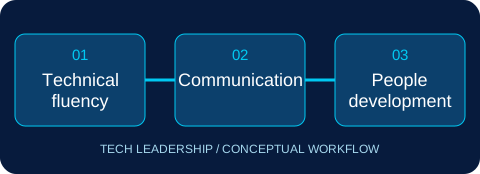
A technical leader does not need to make every implementation decision. The responsibility is to create context, clarify constraints and ensure that important decisions have owners. Ask teams to describe the tradeoff, the evidence and the consequence of being wrong. This supports judgment without turning review into a bottleneck.
A technical decision becomes easier to assess when its assumptions and business effects are visible. Describe what an investment enables, which commitment it delays and what evidence would change the recommendation. This invites a useful challenge before the organization becomes attached to an approach that is costly to reverse.
Rotate opportunities to lead design reviews, investigate incidents and explain architecture. Coaching and shared records reduce dependence on a few individuals while helping newer leaders develop judgment. The goal is not to distribute decisions without support, but to give people enough context and feedback to make them responsibly.
Coaching and succession are part of delivery resilience. Rotate opportunities to lead a design review or incident retrospective. Document why systems work as they do and protect time for learning. A team that depends on one expert may move quickly until that expert is unavailable; visible shared knowledge makes progress more sustainable. A useful leadership review includes what the team will stop doing. New initiatives consume capacity that already has commitments. Make that tradeoff explicit and protect necessary maintenance so an ambitious roadmap does not quietly create a less dependable organization.
Every new initiative draws on people who already have responsibilities. Make the tradeoff visible and include maintenance, recovery practice and learning in the plan. Leadership can then be evaluated through outcomes the team can sustain, rather than a roadmap whose apparent ambition depends on quietly accumulating unsupported work.
Evaluate leadership through outcomes and the team’s ability to sustain them. A roadmap without capacity is only an aspiration. Protect time for maintenance and learning so short-term delivery does not quietly consume the organization’s future capability.
SOURCES & FURTHER READING / Further reading: accountable AI governance
SOFTMAG editorial analysis. Business scenarios and diagrams are explanatory examples.
INDIA’S DIGITAL OPPORTUNITY
Build for the diversity of real users.
India offers opportunities across enterprise software, logistics, education, language access and services for smaller businesses. A useful product begins with a specific community of users. Device capability, connectivity, workflows and purchasing patterns can vary substantially between customers. Trust can depend on small details: a recognizable status message, a clear confirmation or an understandable charge. Research these moments with the intended users. Large audience estimates offer little guidance about the practical experience that leads someone to return.

Original AI-assisted editorial illustration · India’s digital opportunity
Design for intermittent connectivity and recovery after interrupted tasks. Offline records need conflict handling, not just a local cache. Multilingual interfaces also require attention to terminology, input methods and the language in which users seek support. Treat synchronization as a visible workflow. Show what is saved locally, what has reached the shared system and what needs attention. Quietly discarding a conflicting update can damage confidence even if the application appears technically successful.
A field-service application could let technicians record evidence offline and synchronize when connectivity returns. Supervisors receive a clear exception queue for conflicting updates. The design succeeds when it fits the working day rather than requiring users to reorganize around the software.
Distribution and trust matter alongside features. Smaller enterprises may need help with setup, training and predictable pricing. Partnerships can improve access, but the support model must remain viable as the customer base grows.
Validate assumptions region by region and role by role. Measure repeat use, successful task completion and support effort. Do not treat a large potential audience as evidence of demand. Public programs and policy details should be checked directly before making business commitments.
INDIA’S DIGITAL OPPORTUNITY / CONTINUED
A large market is made of specific working lives.
A useful product interview happens where the work occurs. Watch how users enter information, share a device, recover from an interruption and ask for help. Language support is more than translation: terminology, script input and local expectations can change how a workflow should be presented.
Research should follow the task through device sharing, interrupted connectivity and the moment a user asks for help. Language support includes terminology and input methods, not just translated labels. A small design decision can determine whether the application feels trustworthy in the environment where the person actually needs to use it.
An offline update may conflict with a change made elsewhere. Decide whether the system merges, rejects or flags the difference, then show the user what happened. Distinguish information saved on the device from information confirmed by the shared service. Quietly discarding a change can undermine confidence even when the application reports technical success.
Offline design needs an explicit reconciliation policy. A technician may update a record that another colleague has changed while connected. Decide whether to merge, flag or reject the conflict and show the user what happened. Pair the interface with a viable support and training model, particularly when customers have limited time to adopt new software. Test onboarding and support with the same care as the main feature. A product may solve a valuable task yet fail because setup takes too long or help is inaccessible. Evaluate a repeatable route from first use to continuing benefit in each target segment.
A product may solve a valuable task and still fail because onboarding is slow or support is hard to obtain. Test a repeatable route from first use to recurring benefit with each intended segment. Local evidence about adoption and cost-to-serve gives a more useful basis for expansion than an audience estimate alone.

Validate assumptions region by region and role by role. Measure repeat use, successful task completion and support effort. Do not treat a large potential audience as evidence of demand. Public programs and policy details should be checked directly before making business commitments.
SOURCES & FURTHER READING / Further reading: Digital India
SOFTMAG editorial analysis. Business scenarios and diagrams are explanatory examples.
TECH BYTES / AUGUST 2026
A concise, sourced briefing for software and enterprise teams.
18 AUGUST 2026
Mozilla’s release notes say Local Network Access protections now cover WebSocket connections, with a permission request before a site connects to a device on the local network. For enterprise teams, the practical next step is to test workflows that legitimately use local devices and review the relevant browser policies.
Source: Mozilla release notes ↗13 AUGUST 2026
The PostgreSQL project’s release notes describe fixes and call out configuration adjustments or data cleanups that some installations may need. They state that a dump and restore is not required for users already on 18.x. Administrators should read the complete migration notes and rehearse the applicable steps before updating production.
Source: PostgreSQL release notes ↗11 AUGUST 2026
Sarvam and AI4Bharat introduced a benchmark for joint speech recognition and speaker diarization across India’s 22 scheduled languages. The work addresses a gap between single-speaker evaluation and conversations involving interruptions or overlapping speech. It gives teams another way to examine systems expected to identify who said what.
Source: Sarvam research announcement ↗2026 PLATFORM WATCH
Released on 22 April 2026, Kubernetes 1.36, named Haru, introduces stable, beta and alpha enhancements alongside deprecations and removals. Platform teams should review the official announcement and release notes, then test the features and compatibility issues relevant to their workloads. A release headline is a starting point for engineering review.
Source: Kubernetes release announcement ↗Edition coverage: announcements published by 31 August 2026. Release summaries are historical briefs, not instructions to install a particular version today.
SOFTMAG / EDITORIAL
The people behind the ideas, perspectives and stories of SOFTMAG.
Editor-in-Chief
Editor
Co-Editor
Sub-Editor
Share practical engineering lessons, well-documented case studies and informed technology perspectives. Explain the problem, the decisions and the evidence behind your story.
[email protected]
www.softmag.in
Bhubaneswar, Odisha, India
SOFTMAG / THE SOFTWARE MAGAZINE / AUGUST 2026